Antifragile
Updated: Apr 10
In a world that often feels chaotic and unpredictable, the concept of antifragility emerges as a powerful tool for personal and professional growth. Coined by Nassim Nicholas Taleb, antifragility describes systems that gain from disorder and stress, thriving in uncertainty rather than merely surviving it. This blog post will explore how you can cultivate antifragility in your life, turning challenges into opportunities for growth.

Understanding Antifragility
Nassim Nicholas Taleb coined the term Antifragile in his book by that name in 2012. The term has gained in popularity. The mathematics is esoteric.
In short, antifragile is the ability to improve function or capability in the face of adversity—stressors, shocks, volatility, noise, mistakes, faults, attacks or failures. For example, we found that resilience ratios increased rapidly just after Covid-19. Post traumatic growth is expected as a normal response to adversity.
Taleb defined four terms:
Fragile as a system/person that breaks or fails in adversity
Robust as a system/person that resists failure and tolerates high levels of distress
Resilient as a system/person that can recover or adapt from failure
Antifragile as a system/person that capitalises on adversity and chaos
Whilst the concept is applied in risk, physics, biology, planning, engineering, aerospace and computer science, we explore it here as a human dimension. Our diagnostic measures 60 human factors to create a Resilience Ratio. Here is a 2022 sample of 6,567 people with an average ratio of 1.66.
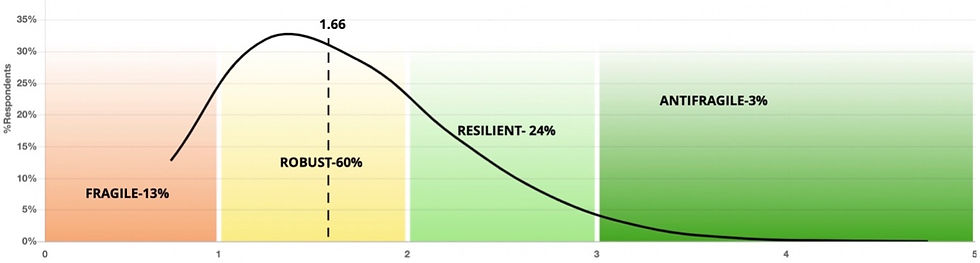
Would it be reasonable to apply these terms to human beings? Using our resilience ratio, we have grouped the distribution of these pre-training participants. Only 3% are Antifragile, 24% are Resilient, 60% are Robust and 13% Fragile. Remember that the sample is from functioning senior staff at work.
What does it mean to be human in each category? The Fragile people are at risk of failure—mental, emotional or physical. They are struggling in their lives and work. The Robust people can resist failure but feel strain and distress. The Resilient people are succeeding in life and work (we have a broader definition of resilience than Taleb).
The Antifragile category are those who are thriving and playful in life and work. Their support systems are in place, their lives have rhythm and work is fulfilling—yet it is only 3% of this sample.
After training we see a marked improvement. Here is a 2022 sample of 2,297 people who have done our resilience training and completed a post assessment. The average resilience ratio is 2.05—a 23.5% improvement.

Post training the Fragile group is down from 13 to 6%. The Antifragile group has increased fourfold to 13%. The first three quarters of 2022 have been testing on multiple fronts and we still see these improvements.
What do we know about the Antifragile people?
Antifragile is not genetic, nor an innate trait. It arises from a set of skills that can be learned and applied in life. Our 2025 Research showed clearly that the top 10% of people prioritise fulfilment, sleep quality, bounce, focus and relaxation. They also minimise worry, rumination, fatigue, anxiety and apathy.
Being Antifragile is not for everyone. It demands daily discipline. The rewards, as Taleb has explained, can be massive. In our volatile times, disruption is inevitable. It is not a good time to be fragile or robust.
Those who train to be antifragile will reap the rewards.

Comments